Tokyo / Ota Accommodation
Grand Grace Zoshiki Apartments by Tranova
Grand Grace Zoshiki by Tranova
Keikyu Zoshiki Station | Four apartment layouts of 43–75㎡ for 3 to 6 guests — compare transport, beds and check-in rules first

Photo source: Trip.com
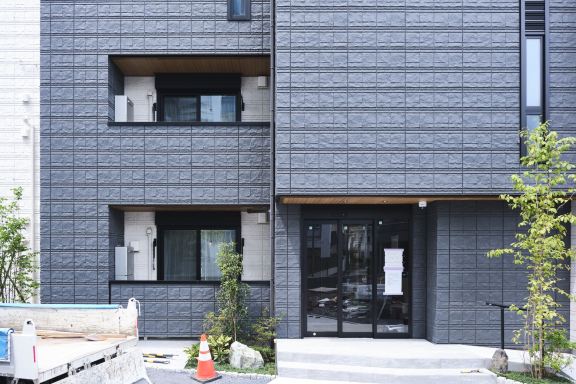
How would I choose this stay?
- The 43–75㎡ room types offer more space for group activity and luggage than a typical business hotel
- This is an apartment-style stay, and the booking information requires contacting the property by email the day before check-in and submitting identity details, after which self check-in information is provided. For a party of four to six, checking bed numbers and the living-room sofa bed early matters more than adding a bed afterwards; and since no breakfast is provided, everyone’s morning meal needs separate planning.
- Advance contact and self check-in are required, so coordinating room entry matters more for group travel
What is most worth looking at at Grand Grace Zoshiki is not one pretty interior photo after another, but the four layouts A, B, C and D: Type A about 43–44㎡, Type B about 67–68㎡, Type C 75㎡, Type D about 43㎡. Booking platforms list the same layout repeatedly under different room numbers, so “101/B” and “Type B” should not be treated as entirely different facility standards.
This is an apartment-style stay, and the booking information requires contacting the property by email the day before check-in and submitting identity details, after which self check-in information is provided. For a party of four to six, checking bed numbers and the living-room sofa bed early matters more than adding a bed afterwards; and since no breakfast is provided, everyone’s morning meal needs separate planning.
Location and transport: how would I get there, and how would I plan Haneda and central Tokyo trips?
The stay’s address is 3-chome-6-1 Higashirokugo, Ota Ward, and Zoshiki Station on the Keikyu Main Line is the main transport station for locating this apartment. Reaching the hotel requires passing through the neighbourhood; it is not directly connected inside the station. If taking Keikyu to and from Haneda, plan time before departure around that day’s train services and the transfer situation at Keikyu Kamata.
Zoshiki sits along the Keikyu Main Line, suiting a plan that puts Haneda and the Kamata area in the same transport frame; but if the trip theme centres on Shinjuku, Ikebukuro and similar places, daily cross-line transfer time must also be counted. This apartment suits travellers who put larger indoor area and splitting the stay among several people first.
The mixed residential-commercial neighbourhood of Higashirokugo suits a living-style trip better, and differs from the foot traffic and price structure beside Tokyo’s major stations. The apartment room-type information provides basic facilities such as a refrigerator and bathroom; anyone wanting to prepare their own dinner or breakfast should first pick a room number with matching kitchen equipment, and must not treat every room in the building as identically equipped.
I would first save the stay’s address in navigation, and when riding trains keep the Japanese station names handy, so as not to mistake different station exits in Ota Ward for the same exit. If on the same day I am dragging luggage, transferring trains and rushing to airport check-in, the whole trip cannot be estimated from station-to-station ride time alone; time is needed separately for getting from the room door to the station, walking to the correct platform and checking in with the airline. The location here is “3-chōme-6-1 Higashirokugō, Ota Ward, Tokyo, 144-0046, Japan”.
Room types and beds compared: check the room number first, then decide which room to book
I would not compare only the cheapest room type at the same stay. What really affects the experience here is each room number’s bed count, area, how many people share the living space, and the balance between sleeping area and luggage passage. When choosing a room, first confirm the actual party size, then compare whether separate beds are possible and how much indoor activity space there is; price and cancellation terms come last.
| Room type / room number | Area | Beds | Listed capacity |
|---|---|---|---|
| Type A Apartment | 43m² | 1 bedroom: 1 single bed, 1 double bed; 1 living room: 1 sofa bed | Up to 4 adults |
| Type B Apartment | 67m² | 2 bedrooms: 2 single beds, 2 double beds; 1 living room | Up to 6 adults |
| Type C Apartment | 75m² | 2 bedrooms: 2 double beds; 1 living room: 1 double bed | Up to 6 adults |
| Type D Apartment | 43m² | 1 bedroom: 1 double bed; 1 living room: 1 sofa bed | Up to 3 adults |
| Room 102 / Type A Apartment | 44m² | 1 bedroom: 1 single bed, 1 double bed; 1 living room: 1 sofa bed | Up to 4 adults |
| Room 104 / Type C Apartment | 75m² | 2 bedrooms: 2 double beds; 1 living room: 1 double bed | Up to 6 adults |
| Room 101 / Type B Apartment | 68m² | 2 bedrooms: 2 single beds, 2 double beds; 1 living room | Up to 6 adults |
Type A Apartment | Beds and luggage layout
The Type A Apartment is listed at 43m², with 1 bedroom: 1 single bed, 1 double bed; 1 living room: 1 sofa bed. The listing shows up to 4 adults can be accommodated, but headcount and whether each person has an independent bed are two different things. The area sits between a small business room and a large apartment, and how activity actually feels depends on how beds, tables and the living area are arranged. The room type is listed as non-smoking, a condition anyone sensitive to smoke must check.

Photo source: Trip.com
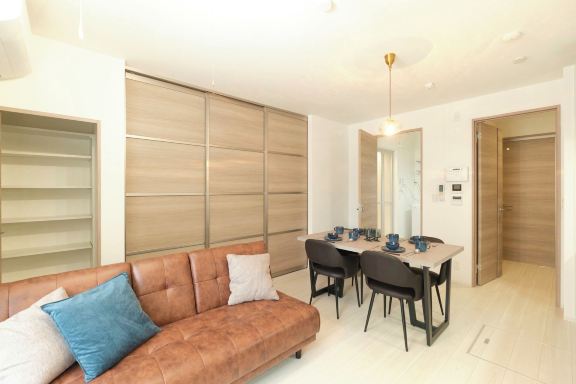
Type B Apartment | Beds and luggage layout
The Type B Apartment is listed at 67m², with 2 bedrooms: 2 single beds, 2 double beds; 1 living room. The listing shows up to 6 adults can be accommodated, but headcount and whether each person has an independent bed are two different things. The larger space suits longer stays or groups, but bedrooms, living room and mattresses are not all independent sleeping rooms; if fellow travellers keep different hours, allocating beds matters more than total area. The room type is listed as non-smoking, a condition anyone sensitive to smoke must check.

Photo source: Trip.com
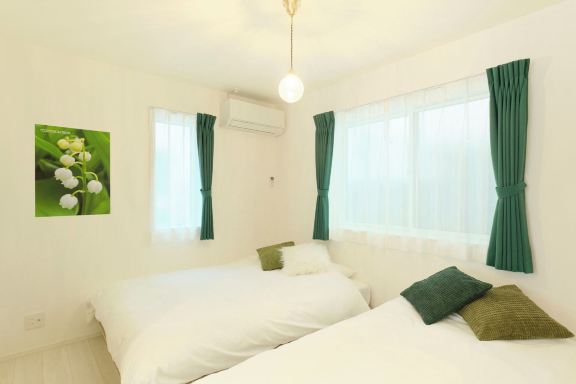
Type C Apartment | Beds and luggage layout
The Type C Apartment is listed at 75m², with 2 bedrooms: 2 double beds; 1 living room: 1 double bed. The listing shows up to 6 adults can be accommodated, but headcount and whether each person has an independent bed are two different things. The larger space suits longer stays or groups, but bedrooms, living room and mattresses are not all independent sleeping rooms; if fellow travellers keep different hours, allocating beds matters more than total area. The room type is listed as non-smoking, a condition anyone sensitive to smoke must check.

Photo source: Trip.com
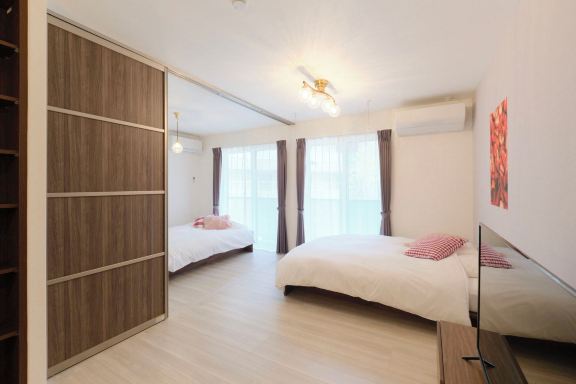
Type D Apartment | Beds and luggage layout
The Type D Apartment is listed at 43m², with 1 bedroom: 1 double bed; 1 living room: 1 sofa bed. The listing shows up to 3 adults can be accommodated, but headcount and whether each person has an independent bed are two different things. The area sits between a small business room and a large apartment, and how activity actually feels depends on how beds, tables and the living area are arranged. The room type is listed as non-smoking, a condition anyone sensitive to smoke must check.

Photo source: Trip.com
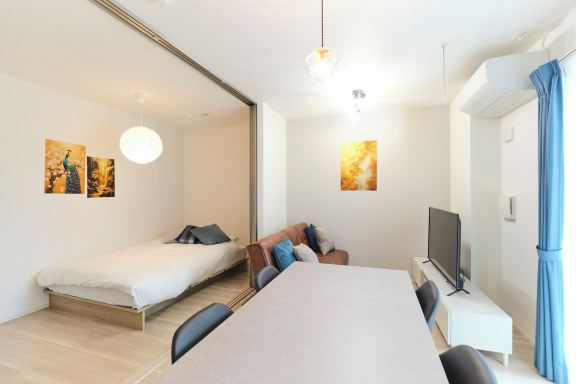
Room 102 / Type A Apartment | Beds and luggage layout
Room 102 / Type A Apartment is listed at 44m², with 1 bedroom: 1 single bed, 1 double bed; 1 living room: 1 sofa bed. The listing shows up to 4 adults can be accommodated, but headcount and whether each person has an independent bed are two different things. The area sits between a small business room and a large apartment, and how activity actually feels depends on how beds, tables and the living area are arranged. The room type is listed as non-smoking, a condition anyone sensitive to smoke must check.
Room 104 / Type C Apartment | Beds and luggage layout
Room 104 / Type C Apartment is listed at 75m², with 2 bedrooms: 2 double beds; 1 living room: 1 double bed. The listing shows up to 6 adults can be accommodated, but headcount and whether each person has an independent bed are two different things. The larger space suits longer stays or groups, but bedrooms, living room and mattresses are not all independent sleeping rooms; if fellow travellers keep different hours, allocating beds matters more than total area. The room type is listed as non-smoking, a condition anyone sensitive to smoke must check.
Room 101 / Type B Apartment | Beds and luggage layout
Room 101 / Type B Apartment is listed at 68m², with 2 bedrooms: 2 single beds, 2 double beds; 1 living room. The listing shows up to 6 adults can be accommodated, but headcount and whether each person has an independent bed are two different things. The larger space suits longer stays or groups, but bedrooms, living room and mattresses are not all independent sleeping rooms; if fellow travellers keep different hours, allocating beds matters more than total area. The room type is listed as non-smoking, a condition anyone sensitive to smoke must check.
The “capacity” above is the booking listing’s arrangement for headcount; it does not mean there are the same number of independent beds. If travelling with friends rather than a partner, I would first check whether everyone can sleep comfortably on their own; families with children should note that free child stays often come with a “no extra bed” condition, so “free” should not be assumed to include a separate child bed.
Only after settling the beds would I compare whether luggage can be opened, whether a desk is needed, and how private and shared space is divided over several nights. For four apartment layouts of 43–75㎡ for 3 to 6 guests like Grand Grace Zoshiki Apartments by Tranova, the room-type name can easily give the wrong impression; the real way to avoid booking the wrong room is to put room number, area, bed count and fellow travellers’ needs in the same table.
Check-in method, living facilities and what staying here feels like
The Type A room photos show the living room and kitchen; Types B and C have different bedroom divisions, and Type D is a smaller combination. These differences matter for families: six people sharing two bedrooms plus living-room beds, with routines interfering with each other, cannot be judged by the same standard as three people in a 43㎡ one-bedroom-plus-living-room unit.
I would arrange check-in conditions according to the room type booked that time and the stay’s policy, rather than mixing photos from different room numbers. This stay’s check-in rules are especially worth remembering: the relevant times and methods are listed in the booking information and should be confirmed before departure. If there is a late flight, staggered arrivals or further transfers, the sooner the door-opening method is sorted out, the less likely the trip is to be disrupted on site.
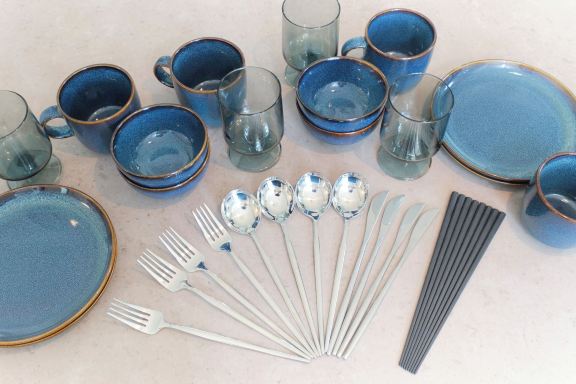
This stay does not provide breakfast, so I would arrange the next day’s food together with departure transport the night before; for a larger party, preparing early is more efficient than splitting up in the morning with luggage to look for restaurants on the spot.

Photo source: Trip.com
How to plan the morning departure and check-out time
It is confirmed that this stay does not provide breakfast. In the morning I would first check whether the day means catching a flight, heading into central Tokyo or checking out to transfer, then decide whether to take breakfast away or use nearby dining options; travelling with family, I would at least reserve time from the room door to the station.
One night versus a longer stay: the criteria are actually different
Just one night: how to arrange departure and check-in?
For just one night with an early departure the next day, I might not treat maximising space as a requirement. When several people share the stay, self check-in and what time keys can be obtained, how to gather the night before, and where each person’s luggage goes are more practical considerations.
If the flight arrives late, I would first arrange that day’s final leg of transport, phone roaming and remaining battery — all the more so for a self check-in stay. One night does not require using every facility; what matters is making sure I can enter the room smoothly, sleep well, and then leave at my own check-out time.
Three nights or more: how to weigh living space against daily routines?
For three or four nights, differences in area start to carry clear value: friends who need to sleep separately could consider the two-bedroom layouts of Types B or C; a small family wanting to keep living-room activity space could look at Types A or D. Cancellation and check-in conditions still follow the room number actually chosen; room-number information must not be ignored just because everything is the same brand.
For a longer stay I would think about bedding layout, daily round-trip transport and laundry storage together: if I use the same station every day, familiarity with its exits may grow more valuable the longer I stay; conversely, a room that is too small or shared areas contested with fellow travellers will also become more obvious. The whole trip should not be decided on how convenient the first night merely looks.
Pros and cons I would put into a booking comparison
This is an apartment-style stay, and the booking information requires contacting the property by email the day before check-in and submitting identity details, after which self check-in information is provided. For a party of four to six, checking bed numbers and the living-room sofa bed early matters more than adding a bed afterwards; and since no breakfast is provided, everyone’s morning meal needs separate planning.
Pros
- The 43–75㎡ room types offer more space for group activity and luggage than a typical business hotel
- The A, B, C and D room types have different bedroom and living-room bed combinations
- The pictures make it possible to tell apart the beds, dining areas and kitchen positions of the various room types
Trade-offs to accept
- Advance contact and self check-in are required, so coordinating room entry matters more for group travel
- No breakfast is provided, so morning plans must be made together with the station route
- Similar room types have different room numbers and bed layouts, so booking the wrong one is easy without checking each one
These pros and cons are not labels of good or bad for the stay; they let each traveller judge by itinerary. If my focus this time is Keikyu Zoshiki Station and the nearby routes, I would raise transport in priority; if there are many fellow travellers and meals or work in the room are also needed, I would first confirm bed types and living space before looking at price.
Conclusion: who would I recommend this to for this Tokyo trip?
I would recommend this to people willing to spend time checking room types and genuinely needing several people to share one accommodation unit. For just two people on a brief overnight stay, choosing 43㎡ or more may not be the most efficient choice; families with children need to first confirm who actually uses each bed.
My booking order is: first confirm the actual hotel address and transport stations, then identify room number, area and beds from the room-type name, then check check-in times and whether self key collection is needed, and finally compare total price. Choosing Grand Grace Zoshiki Apartments by Tranova this way fits the conditions actually needed on the trip better than looking only at star ratings or the lowest nightly price.
Fact-check date: 2026-10-28